
A hopefully diverting account of my first – and possibly last – attempt at making marmalade.
The weekend before last, and the COVID-19 news was getting on top of me. I thought a spot of home cooking might help me calm down and focus on something practical. We had loads of oranges from Waste Not Want Not Battersea that were nagging to be used – bitter oranges. With lockdown looming, what better use for them could there be than to turn them into marmalade?
I settled on an online recipe that sounded fairly straightforward and didn’t require me to soak the oranges in water for 24 hours. I didn’t have any muslin to wrap the pips in, but another online search suggested I could use a clean tea towel instead. As this was my first attempt I decided to make half the quantity, which still left quite a few oranges over. Apron on, I got stuck in.
My chosen recipe instructed me to cut the oranges in half and squeeze the juice out of the fruit into the pan, using a sieve to catch the pips and any pith. There were a lot of pips in the oranges. The next step involved separating the pips and pith – pith into the pan, and pips into the muslin/tea towel. I don’t know why I didn’t simply remove the pips before squeezing the oranges; it would have made the process a lot quicker. Actually, I do know why – in stressful situations, we don’t think straight, and this marmalade-making malarkey was already adding to my stress.
Next step, remove any remaining pith from the peels before slicing them into thin strips. Roughly two hours after I’d started on this journey, I had water, juice, pith and slivers of peel in the pan, and pips tied up in a tea towel.
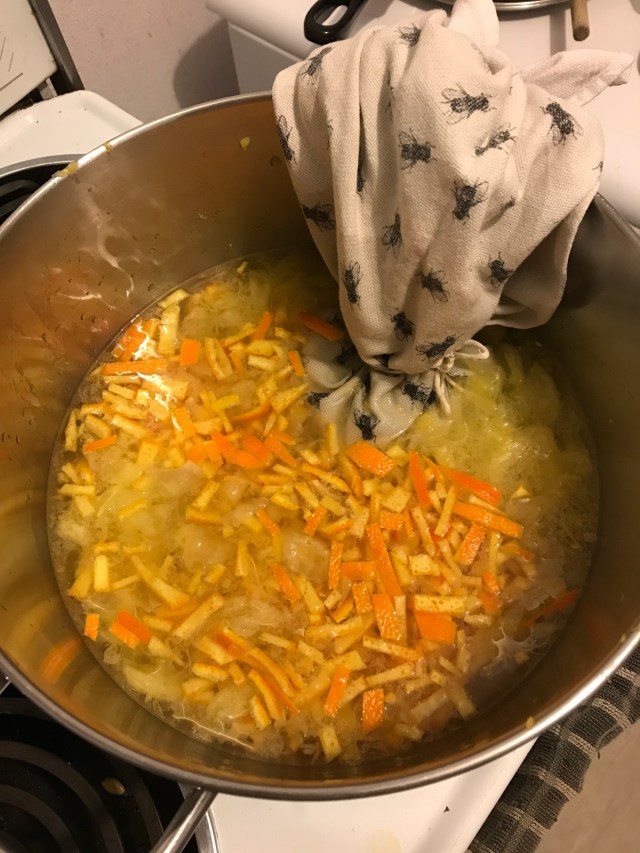
I let the mixture simmer for one and a half hours. At least it infused the flat with a wonderful citrusy aroma! After the specified simmering time, the mix had a reduce a LOT. The next step was to remove the bag of pips and squeeze out us much pectin as possible into the pan. I used a wooden spoon to to do this, then scraped the pips out of the tea towel and tossed it in a bucket to soak. By this stage, I’d resorted to a glass of red wine to help get me through to the finishing line. I was doubtful that the remaining liquid would absorb a kilo of caster sugar, but slowly, magically, as a I steadily stirred, it did.
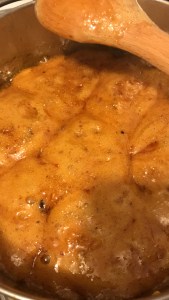
Then, the scary bit: increase the heat to high and boil the marmalade for 15 minutes. To stir or not to stir? The recipe was silent on this point. I stirred intermittently. There was a saucer in the freezer, ready for the next step – testing whether the marmalade had reached setting point. The aroma now was more like toffee…
I tested. It was definitely setting. I took the pan off the heat to let it settle for 10 minutes as instructed, before spooning it into the jars I’d sterilised. I had a sinking feeling this wasn’t going to work out well.
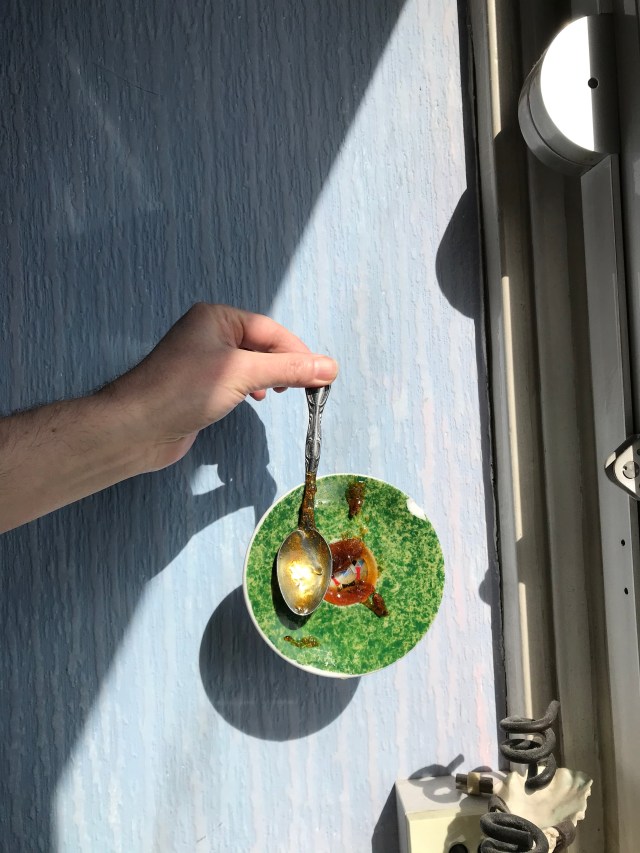
I discovered that the spoon I’d left on the testing saucer was now glued there, in a hard pool of orange marmalade toffee.
Totally perturbed, I carried on and spooned the hot marmalade into the jars and put the lids on. Maybe some marmalade magic would happen overnight and in the morning we’d be able to spoon perfectly set marmalade onto our toast.
Dream on. I opened one of the jars the next day and found the marmalade set hard as toffee. Harder. How was I ever going to get it out of the jars? I left it for a few days. There was lots of advice online abut what to do if your marmalade wasn’t setting, far less about how to fix things if you’d managed to produce a concrete strength variety. Especially if you’d gone as far as putting it into jars. A couple of comments I came across suggested it would be possible to salvage the marmalade – if I could get it out of the jars – by reheating it with some extra water to thin it down before boiling it briefly again. Finally I plucked up my courage and stood one of the jars in a dish of boiling water, slid a hot knife round the edge, down the sides; and once there was some movement, picking the jar up with an oven glove, the lump of marmalade tipped with a satisfying squelch into the waiting pan.
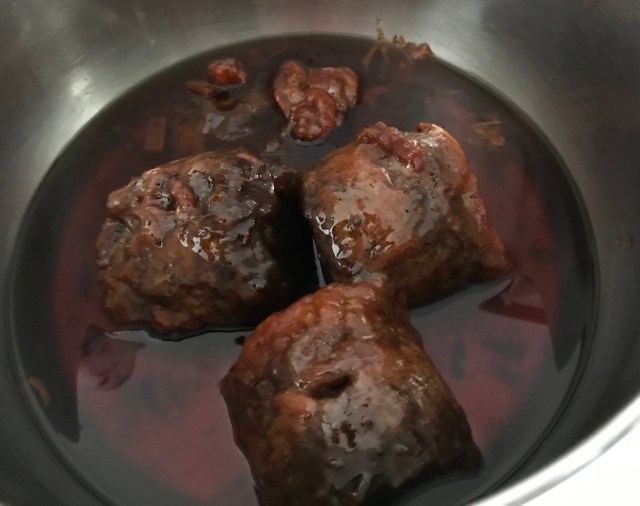
This time, once the marmalade had liquified, I boiled it for no more than 10 minutes, let it sit for a bit, then back in the jars. I still wasn’t confident. The following day I opened a jar and tentatively poked at the surface with a teaspoon. The tip of the teaspoon went in, dug a little marmalade out – success! It’s not rock solid, and it’s also not runny. My double-cooked burnt orange toffee marmalade is actually really rather good. We’ve nearly finished the first jar, and have three more to see us through to the other side of this crisis – fingers crossed. As to the rest of the bitter oranges – I used one to make a vegan orange cake on Sunday, and we’ve squeezed the rest and frozen the juice.


 Hilaire