For some time now, Nick and I have taken it in turns to read a poem aloud before we get up. I’m not quite sure when this habit started, and we don’t stick to it every day, but more often than not now we start the day with a poem.
Sometimes I’ve read from The Poetry Review, which I get as part of my Poetry Society membership. Then there was a period when Nick read poems from Out of Everywhere – linguistically innovative poetry by women in North America & the UK edited by Maggie O’Sullivan, and published by Reality Street Editions in 1996. That had its challenges! How to read aloud a poem with very strong visual elements? It was also a revelation, the anthology packed with exciting work by poets and performers such as Susan Howe, Denise Riley and Carlyle Reedy.
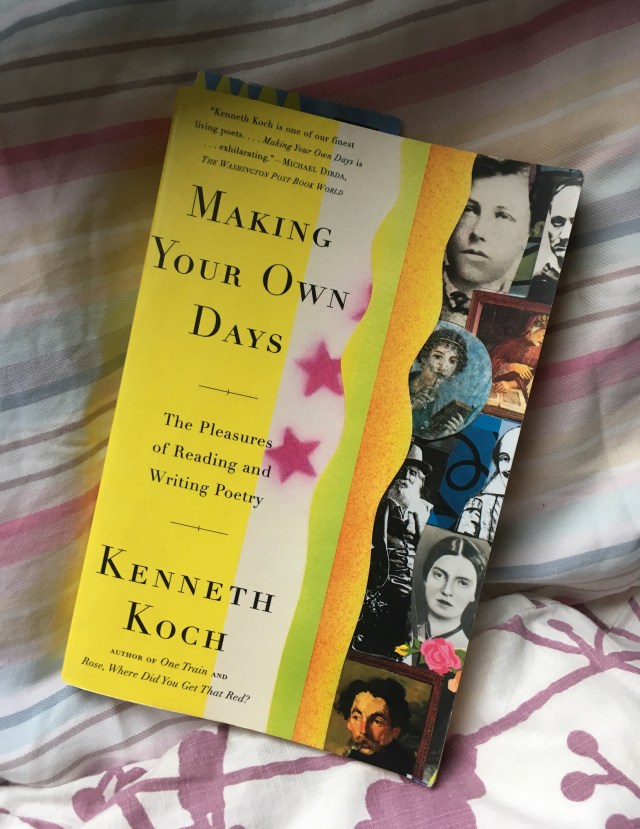
At the moment, I’m reading poems from Making Your Own Days – The Pleasures of Reading and Writing Poetry by Kenneth Koch. In the first part of the book (which I confess I started but haven’t finished), Koch sets out his ideas about the language of poetry (making the case that poetry should be considered a separate language from day-to-day language) and suggests ways to approach reading and writing poetry. The larger part of the book is taken up by an anthology of poems selected by Koch, ranging from Homer and Sappho to Frank O’Hara and Elizabeth Bishop. Each poem or extract is followed by a short commentary by Koch. Once Nick has had a go at guessing the poet (his hit rate is impressive!) and we’ve briefly discussed our responses, I read out Kenneth Koch’s take on the poem, which is often illuminating or helps us appreciate something in a poem which is otherwise not to our taste. And of course we don’t always agree. It’s very rewarding and we’ve made discoveries, for instance the extracts from Chapman’s translation of Homer’s Iliad, and Spenser’s The Faerie Queene, are wonderful. They’re on our list to read aloud together once we’ve finished Don Quixote (currently stalled… ).
The selection of poems contains a fair few translations – good; and a fifth of the poets included are women – could have done better. Shakespeare gets four entries – extracts from Romeo and Juliet and Hamlet plus two poems – which is hard to argue against. On the other hand, including four poems apiece from Wallace Stevens and William Carlos Williams seems surprising to me. Nevertheless, we’re enjoying the journey, and I might even go back and read the first part of the book in due course.
 Hilaire
Thanks, Hilaire, for putting these publications on my reading radar.
My pleasure!
Thanks Hilaire. Just bought the Koch book. Hope we meet up soon. Pete x
Thanks Peter! yes, hope to see you soon – maybe at Free Verse Poetry book Fair? H x