On Tuesday I was privileged to go on a free tour of the National Trust property 575 Wandsworth Road. This was part of an event for the National Park City Festival, a week of events to celebrate London being declared the first National Park City in the world, and encouraging Londoners to get out and discover more of London’s green spaces.
575 Wandsworth Road is a 200 year old terraced house, which was purchased in 1981 by the Kenyan-born polymath Khadambi Asalache. He was a poet, novelist, artist and civil servant, who had travelled widely and also held an MPhil in the Philosophy of Mathematics. The property had previously been squatted, but Khadambi saw its potential, and it was also conveniently located on the route of the 77A bus, on which he travelled to his job in the Treasury. In 1986 he started decorating the interior of the house with hand carved fretwork. The original impetus was to cover up a persistent damp patch on a wall of the lower ground floor dining room, but soon his intricate designs began to spread through the house.
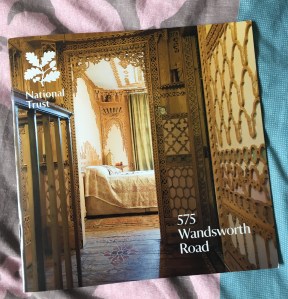
Over 20 years, Khadambi completely transformed the interior of his home. All the fretwork was carved by hand. Almost every surface has been decorated with carvings, painted patterns, or stencil effects which were actually painted by hand. There are eclectic collections of inkwells, lustreware, Coptic crosses, African bracelets, neck rests and more displayed throughout the rooms. In the rear sitting room, a painting by Frank Bowling hangs by the window that overlooks the back garden. The painting originally stood in the garden, near a mimosa tree planted by Khadambi, which unfortunately had to be cut down in 2011 as its roots were undermining the stability of the house. The back garden is not accessible to the public, but it’s clear that the garden was a very important place to Khadambi.
Khadambi left his house to the National Trust after he died in 2006. They took ownership in 2010, and the interior has been fully restored and appears as he left it. Tours are restricted to a maximum of six people at a time, and are usually fully booked well in advance. For National Park City Festival, the National Trust partnered with my local community garden to offer free tours to local people, followed by a workshop in the community garden. It was an opportunity I didn’t want to miss, and the tour of the house more than lived up to my expectations. The care, dedication and joy in Khadambi’s handiwork and his selection of objects and details are truly inspiring.
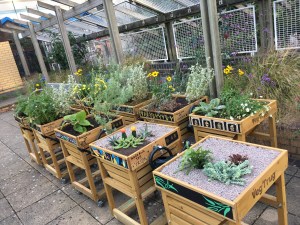
After the tour we walked back in the rising heat to the roof garden, where Think Outside led workshops encouraging each of us to plant and decorate a mobile ‘veg trug’, inspired by some aspect of 575 Wandsworth Road and Khadambi Asalache’s creative life. The variety of approaches and the sheer enjoyment participants got from this activity was wonderful to see. The mobile veg trugs, complete with a small watering can each, will be on display at Battersea Arts Centre from early August.
And Battersea Arts Centre was Nick’s and my destination on Saturday afternoon, for a BBC Proms performance in the recently restored and RIBA award-winning Grand Hall. We weren’t sure what to expect, as the programme featured contemporary composer-performers, all of whom were new to us. Three stages were set up around the hall, and the fully restored Hope-Jones organ ready to go.


The concert was broadcast live on BBC Radio 3, and introduced with panache by Georgia Mann. Jennifer Walshe opened proceedings with a bravura performance of her piece G.L.O.R.I.- a sort of vocal cut-up of popular song lyrics, which had me grinning from ear to ear. Next, Any’s Responses, by Neil Luck, performed by the composer and Musarc, ‘one of the UK’s most progressive choral collectives’, according to the programme. This was witty and unnerving in equal measure.

Later in the programme, there were two more pieces by Neil Luck. Deepy Kaye included images and short film clips projected onto a screen behind Neil and members of Musarc, as well as a live audio description of Neil’s actions, which included shuffling cards and spinning coins on a dinner plate. Somewhere in there was a narrative, based on fan fiction if I heard correctly; as a performance it held my interest, and it wasn’t too long (!), but I wondered what the audio experience was like without the visuals. His last piece, Namesaying, had members of Musarc stationed on each stage, pronouncing nonsense words or names in drawn out phrases, while Neil signalled changes by hitting two wooden sticks together. I found it intriguing and would definitely like to hear this piece again.

Cevanne Horrocks-Hopayian, one half of electronic folk duo Crewdson & Cevanne, was there performing solo arrangements from the duo’s debut album, BRACE. I loved her performances and stage presence. She sported a ‘sonic bonnet’, a bespangled turban incorporating a midi-controller, which she operated by pressing metallic buttons on the headdress to trigger rhythms or effects. Her last song, Sisa’s Well, includes field recordings of the hum from Sizewell nuclear power station, which resonates with her harp. We were near the stage she performed on, and I noticed two little girls right at the front, watching Cevanne and utterly entranced, tapping their heads and moving their arms, imitating her gestures. Two future composers I hope!
There were two more pieces from Jennifer Walshe, the last of which, NATURE IS A MACHINE, inspired by a quote from US entrepreneur Marc Andreessen in which he described reinventing himself every so often as ‘upgrading his operating system’, became gradually hypnotic. Then it was time for the Hope-Jones organ to take centre stage.
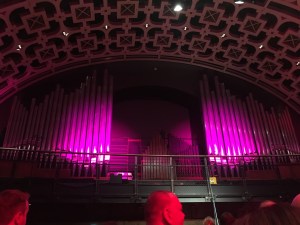 The organ itself was positioned in the auditorium, towards the back. Up on the balcony, the magnificent pipes and bellows were uplit in dark pink. Kit Downes saddled his steed, so to speak, and drew forth some magnificent sounds from the revamped organ, which was originally installed in 1901, when the building was Battersea Town Hall. It’s a powerful beast.
The afternoon’s programme rounded off with five pieces performed by cellist-composer Oliver Coates, who apparently has opened for Thom Yorke and provided the score for a Karl Lagerfeld show, amongst many other credits. I wasn’t really taken by the mix of plangent amplified cello over sweeps of synth sounds and digitised beats. His last piece however, Reunification, was much more to my taste, just the cello with lots of feedback and dirty noise – the opposite of the sweet and mellow sounds usually associated with the instrument (and which I love in many contexts); his Blixa Bargeld moment winning me over at the end.
And a lovely coincidence I found when I read through the programme notes this morning – Cevanne Horrocks-Hopayian was Composer-in-Residence with the London Symphony Orchestra at 575 Wandsworth Road in 2015-17!
 Hilaire
Good to hear Kit Downes saddled his steed to get the most from his organ. Bravo! Sounds like an excellent evening.
Yes it was! Over a year ago now, & so little has changed…